This is how Paris surprised me during the Olympics
I had no idea what Paris would be like during the Olympics and arrived there with a mixture of anticipation and dread. After a week spent watching the Olympic events and strolling the streets of Paris, here is what surprised, dazzled and inspired me about the city and the Games.
Paris felt calm.
Where is everyone? This was certainly not the question I expected to be asked during the Games. A friend flew to Paris for the opening ceremony and the plane was so empty that all the economy class passengers had the luxury of lying flat on the empty seats. Friends happily report that the hardest-to-get restaurant reservations are now easy. I am often the only customer in boutiques and stores. Traffic is restricted on some major arteries, such as Boulevard Saint-Germain, where there is not a private car or bus in sight, which only contributes to experiencing Paris in a very different way. Crossing streets that are not subject to traffic restrictions suddenly becomes easy. Many stores and restaurants increased their staffing levels, and even stayed open during their normal August closure, to serve the Olympic crowds that failed to materialize, impacting their businesses. But as a visitor, it’s nice to visit a peaceful, uncrowded Paris, with almost empty sidewalks and plenty of space on the metro.
Ditch the crowds: The best crowd-free spots in Europe
August is the traditional holiday month in Paris, which partly explains the empty streets, and many more residents have decided to leave the city to avoid potential hassles. More foreign visitors than expected have also chosen to stay away, so much so that Delta Airlines expects a $100 million revenue loss due to the Paris Olympics, according to the CEO.
Although these Games, according to organizers, sell more tickets than any other Olympics, there are still tickets to purchase for many events. Ten million tickets have been distributed for the Games, ranging in price from €24 ($26; £20) to several hundred euros. And then there are the hospitality packages that add transportation, meals, champagne and a great view, but at a steep price. Want to watch the men’s basketball final in style, which could well include some American superstars? This will work out to €6,500 ($7,000; £5,500) per ticket for the hospitality package. Organizers said prices are no higher than previous Games, but many people feel overpriced and the events I attended had empty seats.
The glasses are really spectacular.
Paris does one of the things the French do best: shows, and they can be impressive to see. The French have a long history of understanding the power of spectacle. In the summer of 1676, King Louis XIV ordered hundreds of exotic and extremely expensive white swans – a completely new bird to France – to be imported and released into the Seine. One of the aims was for visitors traveling by boat between Paris and the Palace of Versailles to come across the impressive birds and be amazed by the wonder of the French court. It’s a flair that continues to flourish, and the spirit of French spectacle is everywhere during the Games.
Following the opening ceremony, the Olympic flame completed its long relay journey by lighting a giant cauldron suspended by a hot air balloon rising into the night sky. It floats aloft every evening at dusk until 2 a.m., weather permitting, for the duration of the Games. What’s interesting is that the ring of “fire” in the bowl is not real fire but thousands of LED lights and water mist, which took three years to perfect, and which looks exactly like reality. This is the first time that the Olympic flame is not visible. in fact the flame – in the history of games. The real Olympic flame is a footnote inscribed near the balloon, in the Tuileries gardens, where the first manned hot air balloon was launched in 1783. I found the crowd here: tens of thousands of people line the Seine every evening in the hope of attending the Olympic Games. the cauldron rises into the sky. The French guessed that a spectacle like this would be much more impressive and memorable than seeing the Olympic flame itself. And given the excitement in the streets, it’s clear they were right
48 HOURS IN PARIS: How to make the most of two days in Paris
This sensitivity is found throughout the Games, from the famous (or infamous) opening ceremony to the event locations carefully chosen for their magnificent setting: fences in the immense glass enclosure of the Grand Palais, skateboarding on the Place de Concorde, equestrian sports. events (I went there!) in front of the Palace of Versailles, and beach volleyball under the Eiffel Tower, to name just a few.
There is a volunteer army, and the army.
There are 45,000 volunteers throughout Paris. Each metro station has a team of assistants and each event has hundreds of attendees escorting attendees to and from the venue. They are also present everywhere in Paris in the streets. Easily identifiable volunteers, dressed in bright purple vests, answer questions (in several different languages), hand out water and fans, and generally encourage people.
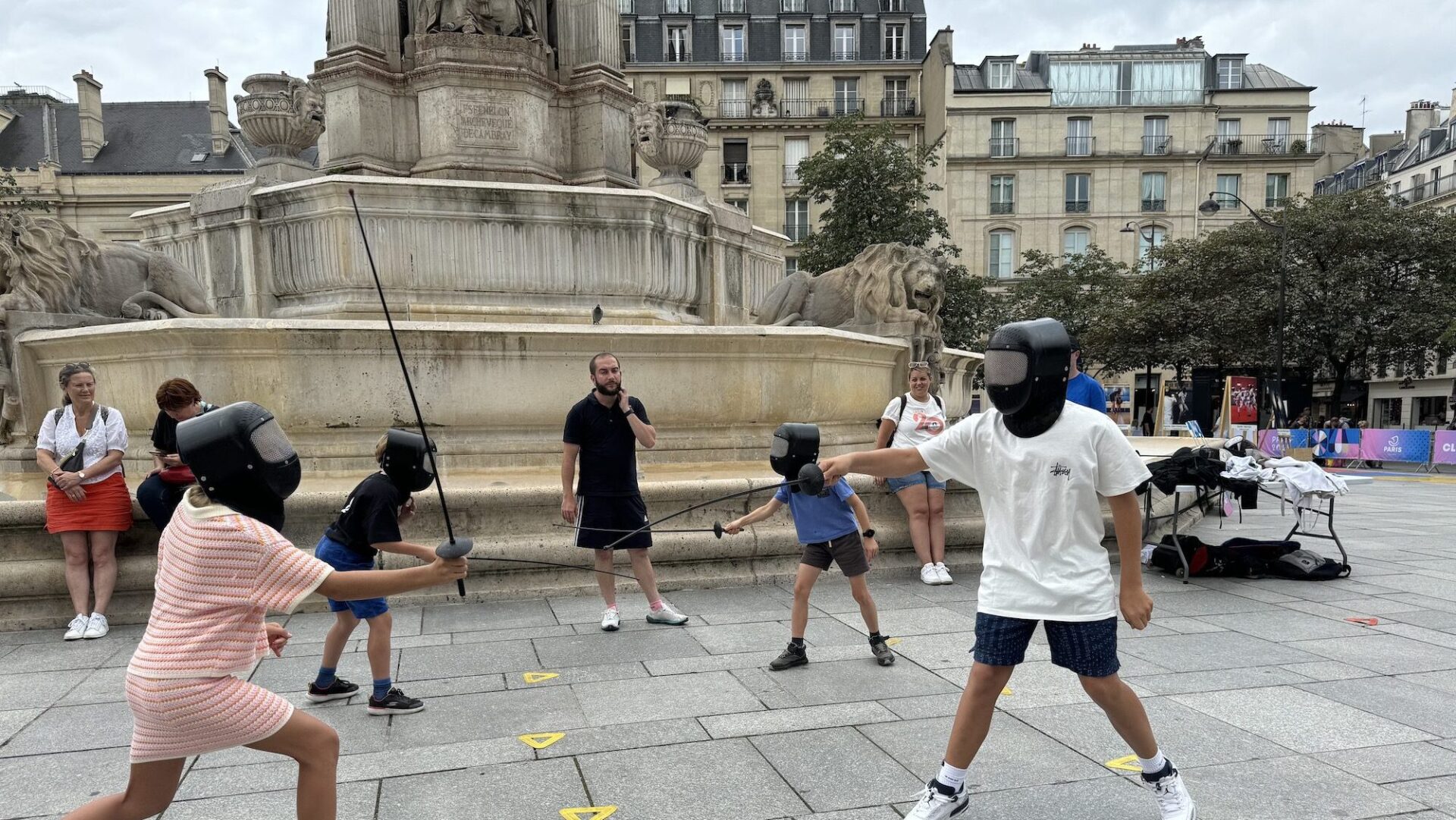
The walk from the buses to the Versailles equestrian events was about a half-mile long and was lined with enthusiastic volunteers wishing us a good day, playing music, encouraging dancing, and joking with the crowd. Special children’s play areas have been set up throughout the city to allow children to try their hand at different sports. I watched as several sets of tiny fencers, equipped with sensor-equipped helmets and protective gear, were instructed by a fencing volunteer on the basics of the sport. Nearby were a three-foot-high basketball hoop, a ping-pong table and uneven bars atop a sea of mats.
PARIS FOR ALL AGES: Are you visiting Paris with young children? Here’s how to make it fun for everyone
France has had a sad history with terrorism and security at the Games is taken very seriously. The presence of police, security and the army is unavoidable on site and throughout the city. Well-armed army patrol units roam the neighborhood streets, making sure everything is safe. Security is enhanced to enter any venue with bag checks and metal detectors. I could have imagined it would be oppressive, but, for me, it makes the Games safer.
Details matter.
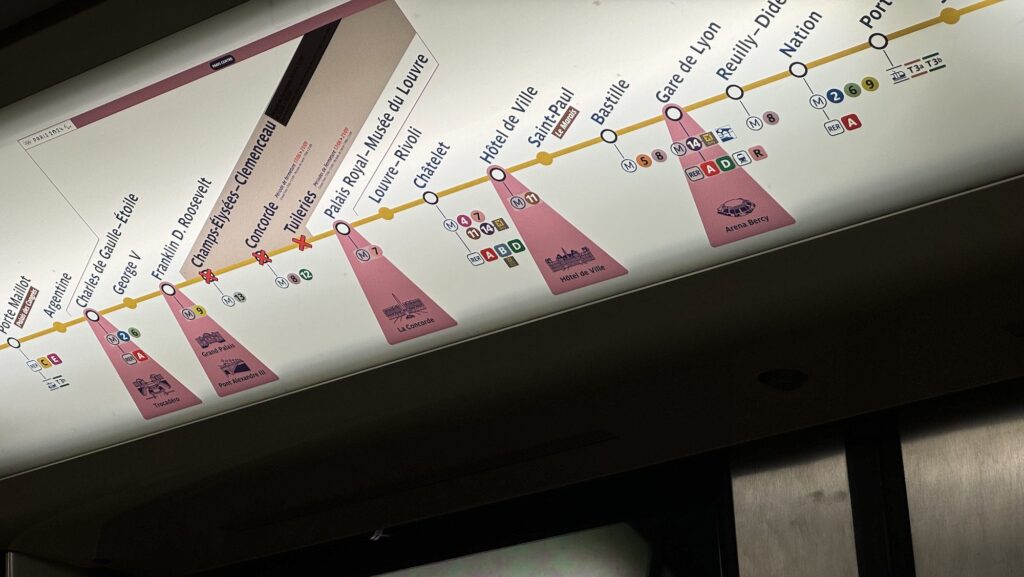
The level of thought and care put into the logistics of the Games is incredible to see. There are event venues all over the city and it can seem complicated for newcomers to the transportation system to get around. The organizers made sure it was easy to find venues. The standard stop chart above the door of each subway car has been replaced with new ones that indicate venue stops, all in the recognizable shade of Olympic pink used by these games.
Once you exit the subway, there are signs at every turn pointing the way to where you need to go. I attended a field hockey game at a stadium slightly out of town, a 15-minute walk from the train station, on the streets of a multi-turn suburb. It could have been complicated without the volunteers and the handy pink stripe painted in the middle of the street to indicate the way.
If a bus is needed to transport people from a train station to an event slightly further away, the process is smooth and organized. Even with an event involving tens of thousands of people leaving at once, there was only a brief wait for a bus and very clear instructions for the buses and their destinations.
And yes, it’s green.
I’ve visited many cities that have imposing buildings outside the center, often moldy and choked with weeds, that were built to host past Olympic events. Paris received mixed reviews for choosing not to install air conditioning in the Olympic village and providing cardboard beds with inflatable mattresses for athletes, but not building new structures to host the hundreds of different games. They made intelligent use of existing sports facilities, sometimes radically redesigning them, such as building a temporary swimming pool above a rugby pitch in a huge stadium to host swimming events. The magnificent equestrian venue was entirely temporary: the portable stands will be dismantled at the end of the Games and the field will be re-grassed.
It really is the game of the worlds
What I remember most about a week in Paris during the Olympics is the breathtaking diversity of nations, events and languages at every turn. Walking down the street, it’s easy to hear dozens of different languages and see supporters waving such a diversity of flags that it would be difficult for a geography student to identify them all.
Some countries clearly dominate non-Olympic sport when it comes to fan attire at events. The Dutch can be seen all over Paris dressed in bright orange, a color associated with the country since William of Orange led a revolt against the Spanish in the 16thth century. I went to a women’s field hockey event, which pitted Belgium against the Netherlands, an old rivalry. It was great fun to see tens of thousands of people wearing bright orange. A Dutch guy told me that they take the sport very seriously and travel everywhere to support their teams.
I loved the good humor and support from the fans at the events I attended, as well as dozens of others attended by friends. During a Germany vs. China match, the mostly European crowd clearly supported Germany, who were dominating. But when China scored their first goal, the crowd erupted in joy. It was the same thing in show jumping. Regardless of the country, the crowd was respectfully silent, with collective screams when a fence fell and applause for every horse and rider crossing the finish line. My friends who have attended some of the biggest events said the roar was deafening as the crowds supported the athletes from many countries.
This week has been like a little break from all the divisions in the world, a glimpse of a place where we are all just humans together, albeit a world in which some are capable of physical feats far greater than mere mortals .
More from FamilyVacationist:

Related Posts
Argentina Menghadapi Proses Disiplin FIFA Atas Dugaan Pelanggaran Piala Dunia – complex.com
Apakah Messi bermain hari ini? Apa yang perlu diketahui tentang MLS All-Star Game 2026 – Yahoo Sports